
The real reason Xi met Biden
Source: The Australian Financial Review | Original Published At: 2023-11-17 00:46:00 UTC
Key Points
- Xi and Biden's meeting focused on restoring communication channels amid tense US-China relations.
- Economic concerns dominated Xi's agenda, aiming to reassure foreign investors amid China's economic slowdown.
- Biden sought to stabilize ties ahead of US elections while maintaining a 'de-risking' strategy against China.
- Significant disagreements persist over Taiwan, trade policies, and geopolitical influence in the Indo-Pacific.
- Both leaders face domestic political pressures influencing their approaches to bilateral relations.
Biden also faces the lowest approval rating of any president since World War II and he is entering an election year. Concerns about China have already been an early feature in the 2024 presidential race.
The four-hour meeting between Biden and Xi on Wednesday (Thursday AEDT) saw lines of communication restored so that, as Biden said, if needed “we should pick up the phone and call one another, and we’ll take the call”.
“The amount of preparation that went into this summit is extraordinary,” Lowy Institute senior fellow Richard McGregor says, referring to the string of high-level meetings between China’s Foreign Minister Wang Yi and top US officials in the weeks leading up to the leaders’ summit.
Leaders pose for a “family photo” at the annual Asia-Pacific Economic Cooperation summit. AP
“That normally would raise expectations for something substantial to come out of it, but both sides lowered expectations going into it. Just to get to the table took an extraordinary amount of work.”
While restoring communication might go some way in terms of avoiding a crisis, especially ahead of January’s presidential elections in Taiwan, much more needs to be done
Huge differences remain between the leaders on Taiwan’s future, with Xi warning Biden to stop selling arms to the self-governed island nation which he still wants to be reunified with mainland China.
“No key leader meeting will ‘talk them out of it’. China might ease off for a bit – a matter of weeks or a month or two – but the pressure will keep getting turned up,” Grant Newsham, a senior research fellow at the Japan Forum for Strategic Studies, says.
But, for now, the economy appears to be the main game for Xi.
At a dinner with top US executives after his meeting with Biden he told the business leaders that China remains open for business. But they have heard promises about “reform and opening” from Beijing before, and the view remains that there’s risk to doing business in China.
The dinner attracted nearly 400 people, including Tesla boss Elon Musk, Salesforce CEO Marc Benioff, Boeing CEO Stan Deal, FedEx CEO Raj Subramaniam, Visa chief Ryan McInerney, Bridgewater Associates’ Ray Dalio, Pfizer chairman and CEO Albert Bourla, Mastercard chairman Merit Janow, and BlackRock’s Larry Fink.
Senior analyst at political risk consultancy Eurasia Group, Dominic Chiu, says Xi’s efforts in San Francisco were focused on getting the Chinese economy back on track.
“Xi is concerned with foreign businesses divesting from China because it makes his domestic economic challenges more difficult to address. People in China have accepted a continuously growing economy as the norm for the last few decades, and it is only beginning to dawn on them that it might no longer be the case.”
“Xi does not want this issue, together with the increasingly tense political climate for foreign businesses in China, to end up creating a vicious cycle of foreign investors pulling out of China and economic decline.”
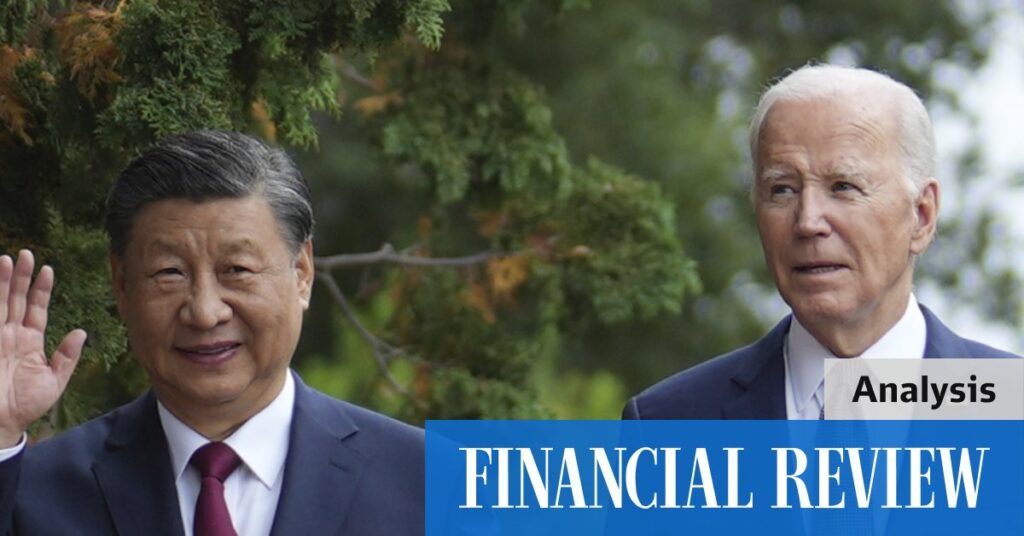
Joe Biden greets Xi Jinping at the Filoli Estate in Woodside, California, on the sidelines of the APEC meeting. AP
Chiu says Xi’s last trip abroad – to South Africa for the BRICS Summit in August – was poorly arranged and for various optics-related reasons made him look bad. Xi was a no-show at the G20 summit in India in September.
“This meeting with Biden will help to restore that image domestically and give the state media something good to write about for the audience back home.”
China’s state-controlled media was flooded with positive stories about the meeting on Friday. A senior Foreign Ministry official posted photos of a young Xi posing in front of the Golden Gate Bridge, and an image of the Flying Tigers, a squadron of US fighter pilots who defended China against Japan in World War II.
“San Francisco can be a new starting point for stabilising China-US relations,” a Foreign Ministry spokeswoman said on Thursday night.
This week the streets of San Francisco had dozens of giant Chinese flags and copies of the China Daily were floating everywhere with front page photos of Chinese waving flags in support of Xi. But there were also fights between pro- and anti-CCP protesters who chanted loudly well into the evening.
In the last few months, Xi has tried to improve his image by engaging with business representatives such as Bill Gates, a congressional delegation led by Senate Majority Leader Chuck Schumer, and American leaders such as California Governor Gavin Newsom.
For Biden, Chiu says the meeting was also “an opportunity to stabilise ties through an election year”.
But Americans have become increasingly sceptical of China and that will play into the presidential election less than a year away. Some 58 per cent of Americans say China is a “critical threat”, according to the Chicago Council on Global Affairs, which has been polling Americans on China since 1990.
In the past two years, there have been more than 180 incidents of Chinese aggression against US aircraft alone in the Indo-Pacific. In September, US Commerce Secretary Gina Raimondo said she was “firm” in confronting the Chinese leadership during a recent visit to Beijing about how her own email being hacked by the Chinese.
Biden has been walking a fine line on China. His administration has kept all the Trump-era tariffs on China. His administration has strengthened the so-called Quadrilateral Dialogues that were resurrected in the Trump administration in 2017.
“We put together the Quad, which [China] didn’t like. I did a few little things like … allow Australia to have access to new submarines,” he said, referring to the AUKUS nuclear submarine deal with Australia that China has railed against.
Biden, who reaffirmed earlier remarks that Xi is a “dictator”, has also ramped up a “de-risking” campaign where America tries to produce and manufacture more of the things that China is dominant in doing, such as semiconductors and electric vehicles.
“Congress, particularly China hawks, will pressure the Biden administration to continue its so-called “de-risking” campaign,” say analysts at Washington-based Beacon Policy Advisors’ Brandon Barford. “Doing so is also important to build the president’s track record as being tough on China for his re-election campaign.”
Biden was quick to point out his own priorities, saying after the meeting with Xi that it was the American voter he had in mind when dealing with China.
“That’s what this is about: to find a place where we can come together and where we find mutual interests, but, most importantly from my perspective, that are in the interests of the American people.”
It was domestic politics that got Biden and Xi into power, and it’s domestic politics that will keep them there too.