
The New African Order
Source: Foreign Affairs | Original Published At: 2025-10-24 04:00:00 UTC
Key Points
- Nigeria and South Africa are positioned to lead African economic integration amid global geopolitical shifts.
- A more cohesive African bloc could negotiate better trade terms and shape global rules.
- Historical precedents like the African Union and NEPAD show potential for pan-African collaboration.
- Current domestic challenges in both countries have weakened past pan-African initiatives.
- The African Continental Free Trade Area (AfCFTA) requires stronger bilateral cooperation to succeed.
- Joint investments in infrastructure, manufacturing, and technology could attract FDI and drive industrialization.
- Nigeria's demographic pressures and South Africa's economic stagnation necessitate urgent collaboration.
- Both countries should support each other's diplomatic priorities and regional integration efforts.
As U.S. President Donald Trump dismantles the post-1945 liberal international order, some analysts insist that the disruption could be positive for countries that have found themselves on the periphery of the old regime. According to this logic, African countries would be more likely to attract investment and trade opportunities in a system less concerned about issues of democracy and good governance. But Trump’s world, one in which raw coercion shapes geopolitics, is dangerous for states that have limited influence in the global economy. Succeeding in a deal-making era requires leverage that most African countries lack: the continent is home to about 20 percent of the world’s population but only five percent of its economic activity.
African countries would stand a better chance of thriving in the postliberal international order if they came together. Closer coordination among even just a few influential African states could quicken the pace of economic integration on the continent, foster larger markets, and accelerate industrialization. Greater cohesion would also give the region more leverage in trade and investment negotiations with outside powers.
Such coordination is difficult to engineer, but not impossible. Between the 1950s and the 1970s, as former colonies gained independence from receding European empires, African countries united around a shared commitment to self-determination. Leaders across the continent exchanged ideas, financial resources, and weapons in support of one another’s independence movements. When Ghana won self-rule in 1957, its leader, Kwame Nkrumah, declared that the country’s independence would be “meaningless until it is linked up with the total liberation of the African continent.” And in 1963, the leaders of 32 newly independent African states met in Addis Ababa to create the Organization of African Unity. The OAU, the continent’s first multilateral institution, became instrumental in coordinating support for African independence movements and forging an international consensus in support of African liberation.
African unity during this period was propelled by moral purpose and championed by the leaders of the first states to gain independence, including Ghana, Senegal, Tanzania, and Zambia. That ethos united elites across borders, ethnicities, and languages, forging a powerful consensus in favor of independence. In today’s more transactional era, African unity is best advanced by a common economic agenda. Two of the continent’s most powerful countries, Nigeria and South Africa, are best equipped to lead the charge. Together, they can amass the geopolitical clout, financial resources, and cultural influence needed to rally a plurality, if not a majority, of African countries behind a global vision. A more cohesive African bloc could extract more concessions from its trading partners and have more say in shaping global trade rules. To be sure, Africa is a vast and diverse continent, and its many states often have competing interests and foreign policies. But success in the dog-eat-dog world of Trumpian transactionalism won’t come from African countries’ ruggedly pursuing their own national interests; they will prosper only if they work together.
Back to the Future
South Africa and Nigeria, the two largest economies on the continent, are best positioned to assume the mantle of African leadership in this new era. Nigeria, the most populous country with over 230 million people, wields significant cultural influence across the region and internationally. Its musicians dominate the globally popular genre of music known as Afrobeats, its films are watched all over the continent, and its fashion trends influence global brands. South Africa, Africa’s most industrialized economy, has comparatively less cultural influence across the region. But it has greater global geopolitical heft than Nigeria, owing to its stronger and deeply rooted financial markets, which could help it raise funds to invest across the region. South Africa is already an important global actor, as a member of the G-20 and an early member of the BRICS grouping alongside Brazil, Russia, India, and China.
Partnership between Nigeria and South Africa is not unprecedented. In the early years of the twenty-first century, the two countries helped reshape the continent’s institutional frameworks. Their presidents at the time, Nigeria’s Olusegun Obasanjo and South Africa’s Thabo Mbeki, shared a pan-African vision of advancing “African solutions to African problems.” In 2002, they championed the replacement of the Organization of African Unity with the African Union, with the mandate to deepen regional integration—recognizing that economic interdependence would help preserve unity. Mbeki and Obasanjo also worked together to form auxiliary AU institutions: the New Partnership for Africa’s Development, focused on economic growth; the Pan-African Parliament, the legislative organ advising and exercising oversight over the AU; and the Peer Review Mechanism, which monitors progress in key governance indicators across the continent.
Since then, domestic pressures in both countries have undermined these pan-African initiatives. South Africa has been stuck in a low-growth trap since the 2008 financial crisis, averaging just above one percent GDP growth annually. This slump has accentuated racially-based inequalities in income and wealth and fueled frustration with the political establishment. The subsequent rise of economic populism has heightened fiscal risks, as governments feel obliged to increase public spending in order to win elections. That pressure has also narrowed the space for pan-African initiatives: amid domestic discontent, South African leaders had neither the fiscal room nor the ambition to pursue projects abroad. In the past two decades, Nigeria struggled to sustain economic growth at a pace that could propel the country to middle-income status. That sluggish growth deepened religious and ethnic fault lines and allowed political opportunists to foment violence, forcing the authorities to focus on maintaining stability rather than spur economic transformation. As slow growth dampened ambitions in both countries, the AU slumbered without strong leadership. Today, the institution has little influence over the behavior of states and is not seen as a leader on any critical regional economic or political issue.
Greater economic integration would better position the continent to navigate a more transactional global order. Trump’s tariffs have raised calls in South Africa and Nigeria to strengthen bilateral and regional ties to compensate for the potential loss of the U.S. market. In August, South African President Cyril Ramaphosa said his country would seek to broker more trade deals with other countries to offset the impact of Washington’s 30 percent tariffs on South African exports. A subsequent South African trade delegation to Nigeria brought business leaders and policymakers from both countries together to discuss opportunities for cooperation across key sectors, including mining and manufacturing. Participants agreed that deepening intra-African trade would help drive industrialization across the continent. This should be an attractive proposition for South African companies: the country’s exports to the African continent are already three times more than those to the United States. Nigeria is also more likely to export value-added or manufactured goods to other African countries, compared with the mostly raw commodities it currently exports to Europe and the United States.
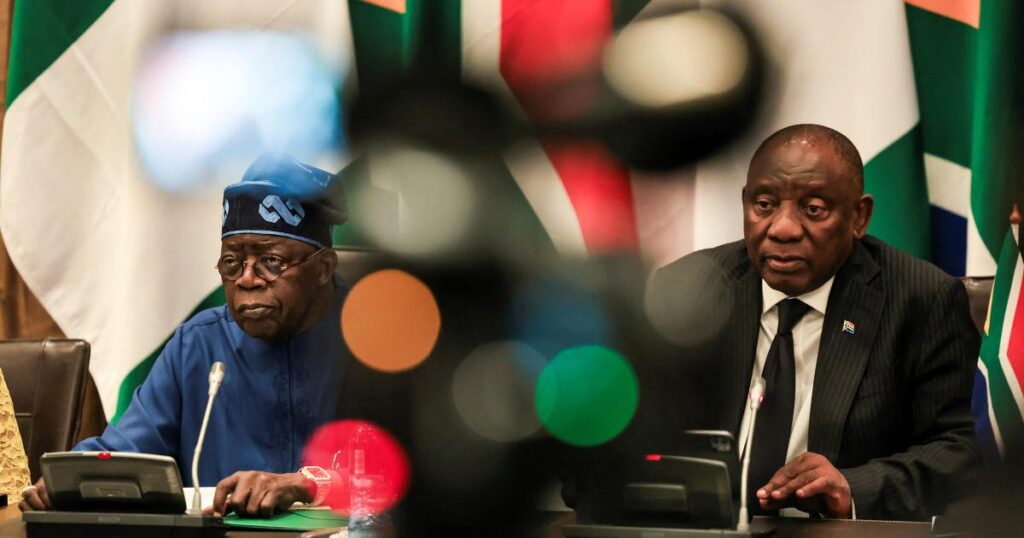
Current leaders in Nigeria and South Africa are poised to drive such deeper integration. Under its current president, Bola Tinubu, Nigeria has demonstrated more ambition in its foreign policy than it has in nearly two decades. For example, it led the region’s response to the 2023 coup in Niger, campaigned for membership in the G-20 and BRICS blocs, and cultivated economic partnerships with key countries in the global South, notably Brazil and India. Ramaphosa has also championed continental causes such as a permanent G-20 seat for the AU and increased global funding for African scientists. If South Africa and Nigeria meld their complementary strengths, they could wield greater economic power and revive continental cohesion to advance national and pan-African interests. Together they can rally African countries behind common positions on climate policy, trade, and regional security, strengthening the continent’s geopolitical leverage.
Building Blocks
Together, Nigeria and South Africa constitute about a third of Africa’s economic activity. They are home to many of the continent’s largest companies: for example, South African telecom and retail firms are dominant across the continent, and Nigerian banks and payment firms operate widely across the region. Access to a more integrated continental market would allow these companies to scale up production and lower operating costs, offering consumers more options at lower prices. Greater collaboration between Nigerian and South African firms could strengthen capital-intensive industries such as automobiles, pharmaceuticals, and steel and attract more foreign direct investment in both countries.
Both countries are desperately in need of an economic boost. Nigeria, set to be the world’s third most populous country by 2050, must create greater economic opportunities for its young people. Over half of its population is under 20 years old, and about three million Nigerians enter the workforce annually. Nigeria needs investment to accelerate industrialization and avoid the worst-case scenario of its demographic boom: millions of unemployed and frustrated youths turning to criminal activity. Similarly, 30 years after South Africa’s transition to multiracial democracy, citizens have grown frustrated by the slow pace of economic transformation and the integration of the country’s Black majority into the white-dominated economy. A failure to boost growth in either country would exacerbate existing sociopolitical fissures and encourage radical political movements that seek a hurried overturn of the status quo.
To achieve closer economic cooperation, leaders in both countries should first improve basic bilateral coordination. South Africa would benefit from Nigeria’s public backing of its diplomatic priorities, including support for Palestinian self-determination. In February, Trump disparaged reforms aimed at addressing the legacy of the apartheid era, falsely accusing South Africa of engaging in “land grabs.’’ The United States subsequently halted public health assistance to the country. Nigeria should have issued a statement reiterating its support for South Africa’s efforts to address historical land inequities. Similarly, South Africa should coordinate more closely with—and champion—Nigeria’s bid to join the G-20 and BRICS.
Succeeding in a world of economic deal-making requires economic leverage.
Implementation of the African Continental Free Trade Area should also be a major focus of cooperation between the two countries. The agreement encompasses 54 African countries and 1.4 billion people and aims to eliminate tariffs on 90 percent of goods traded among member states—creating a single $3.4 trillion market for goods and services across the continent. But trading under its auspices has been limited since it took effect in 2021, largely because of low productivity in member states and weak regional infrastructure. As a result, few products can credibly benefit from the removal of tariffs. Closer cooperation between Nigeria and South Africa to standardize regulatory requirements and develop complementary industrial strategies could encourage more intracontinental trade.
If the continent’s two largest economies demonstrated a strong commitment to regional integration and trade, investors would be more inclined to take advantage of the accord and commit to production in the region, stimulating further cooperation across the free trade area. Both the Nigerian and South African governments could also pool capital to support startups and industrial research in priority sectors, such as advanced intelligence, defense, medical science, and mining technology. The project of regional integration should start with these basic bilateral steps. But over time, South Africa and Nigeria should seek buy-in from other continental power brokers, such as Egypt, Morocco, and Algeria.
As Trump’s transactionalism reshapes geopolitics, it might seem natural for Abuja and Pretoria to resort to rivalry. But they have come together to lead the continent before and should do so again—not out of altruism, but as the best path to secure their interests. If Nigeria and South Africa can recognize their complementary strengths, they can lead Africa into a new era.