
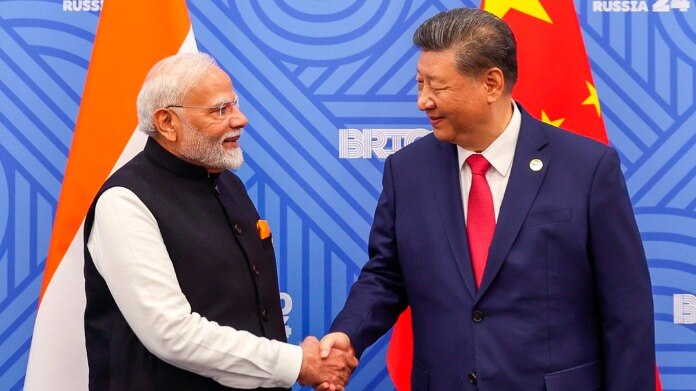
Source: India Today | Original Published At: 2024-10-24 08:12:35 UTC
Key Points
- Modi-Xi meeting marks first bilateral talks in five years during BRICS Summit
- Both sides welcome resolution of four-year Ladakh border standoff
- Joint statements highlight divergent priorities: India emphasizes border peace as foundational, China prioritizes broader relationship
- Analysis reveals differences in framing of border issues, multipolarity, and Global South positioning
- Shared emphasis on strategic communication and restarting diplomatic mechanisms
Prime Minister Narendra Modi and Chinese President Xi Jinping met for the first time in five years on Wednesday at the sidelines of the BRICS Summit in Russia, days after the two Asian giants agreed to resume patrolling in the disputed areas along the Line of Actual Control (LAC) in eastern Ladakh, ending a four-year military standoff.
During the talks on Wednesday, both PM Modi and Xi welcomed the border agreement and underscored the importance of properly handling differences and disputes to not disturb peace and tranquility in border areas. Both leaders stressed more communication and cooperation, and the need to maintain mutual trust, signalling a thaw in ties for the first time since 2020.
India Today accessed the similarities and differences of the joint statements released by both countries following the meeting decoded by Tanvi Madan, a senior fellow in the Center for Asia Policy Studies at the Brookings Institution in Washington DC. Her work focuses on India’s role in the world and its foreign policy, particularly pertaining to the country’s ties with China and the US.
THE DIFFERENCES
1. Beyond the difference in length, one thing that’s immediately noticeable is that China’s statement doesn’t mention the border till the fifth para while India mentions it upfront.
2. This is reflective of a theme in these statements that does not seem to have changed from the statements of China and India over the last few years – that India prioritises the border issue and thinks peace and tranquility is a “must have”. China, on the other hand, prioritises the broader relationship and other priorities with peace and tranquility at the border as a “nice thing to have” – more importantly, they don’t want any disagreements there to derail the broader relations.
You also see China calling for officials’ meetings to get the relationship back on track “at an early date” – while India emphasises it wants Special Representatives (SR) talks on the boundary question “at an early date”.
— China says, “It is in the fundamental interest of our two countries and two peoples to keep to the trend of history and the right direction of bilateral relations. They should maintain a good strategic perception of each other, and work together to find the right and bright path for big, neighbouring countries to live in harmony and develop side by side. They agreed to prevent specific disagreements from affecting the overall relationship countries to live in harmony and develop side by side.”
— India says, “Prime Minister Modi underscored the importance of properly handling differences and disputes and not allowing them to disturb peace and tranquility.” That was required for “stable, predictable, and amicable bilateral relations” and that, in turn, would have a “positive impact” on other things.
3. Only China notes that the two countries should have opportunities, but not vulnerabilities.
— “The two sides should continue to uphold their important understandings, including that China and India are each other’s development opportunity rather than a threat, and cooperation partner, rather than a competitor.”
4. On the border question, China is much vaguer.
— China says, “The two leaders commended the important progress the two sides had recently made through intensive communication on resolving the relevant issues in the border areas.”
— India says, “The Prime Minister welcomed “the recent agreement for complete disengagement and resolution of issues that arose in 2020 in the India-China border areas”.
5. China’s narrative is that PM Modi is the one who wants more improvement in ties.
— “Prime Minister Modi made suggestions on improving and developing the relationship, which President Xi agreed to in principle.”
6. Three mutuals or just one:
— PM Modi, in his opening remarks, once again noted the three mutuals: “Mutual trust, mutual respect and mutual sensitivity should continue to be the basis of our relations.”
— In China’s statement, “President Xi pointed out that the two sides should enhance strategic mutual trust.”
7. Multipolarity: China’s statement mentions a multipolar world three times, but unlike India’s, there is no mention of a multipolar Asia.
— China says, “The two countries must contribute to promoting a multipolar world”, “Prime Minister Modi noted two ancient civilisations and engines of economic growth, can help drive economic recovery and promote multipolarity in the world”. “The two sides agreed to contribute to advancing multipolarity in the world.”
— India says, “The two leaders affirmed that stable, predictable and amicable bilateral relations between India and China will also contribute to a multi-polar Asia and a multi-polar world.”
8. Finally, China has declared itself as an “important member of the Global South”.
— India does not describe China as a Global South country and has not invited it for India’s voice in Global South summits.
THE SIMILARITIES
1. In terms of similarities, some overlaps have been found in the joint statements of both India and China.
— China’s statement notes that “the two sides should strengthen communication and cooperation, enhance strategic mutual trust and facilitate each other’s pursuit of development aspirations. They agreed to view and handle China-India relations from a strategic height and long-term perspective.”
— India says, “The leaders underlined the need to progress bilateral relations from a strategic and long-term perspective, enhance strategic communication and explore cooperation to address developmental challenges.”
2. The mention of restart of official mechanisms reflects some divergence.
— China says, “The two sides agreed to make good use of the Special Representatives mechanism on the China-India boundary question, ensure peace and tranquility in the border areas, and find a fair and reasonable settlement. The two sides agreed on holding talks between their foreign ministers and officials at various levels to bring the relationship back to sound and steady development at an early date.”
— India says, “The two leaders agreed that the Special Representatives on the India-China boundary question will meet at an early date to oversee the management of peace and tranquility in border areas and to explore a fair, reasonable and mutually acceptable solution to the boundary question. The relevant dialogue mechanisms at the level of foreign ministers and other officials will also be utilised to stabilise and rebuild bilateral relations.”