
Xi and Putin rewrite past and future together at Victory Day parade
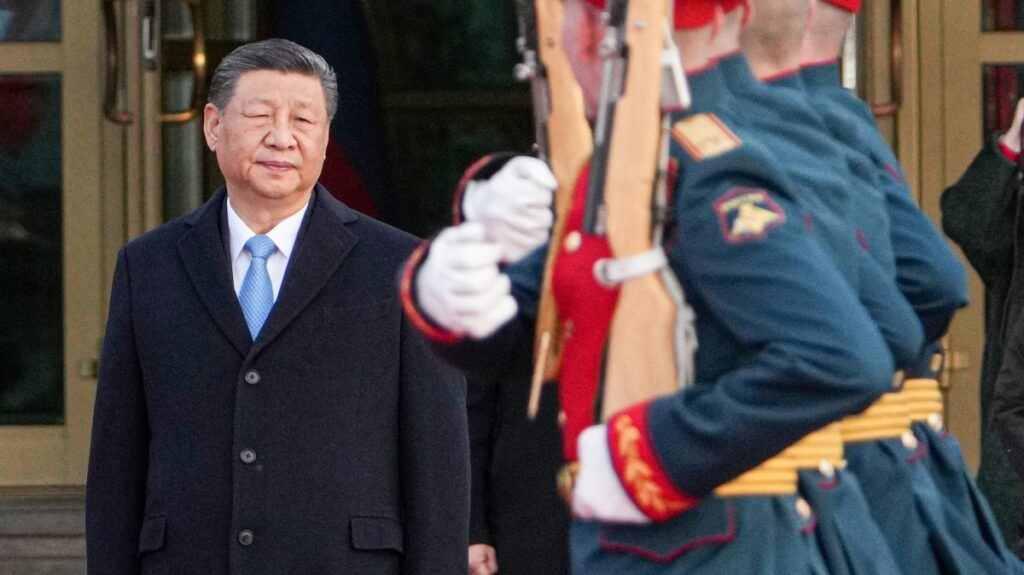
Source: The Times | Original Published At: 2025-05-07 18:50:26 UTC
Key Points
- Xi Jinping's four-day visit to Moscow coincides with Russia's Victory Day parade, emphasizing Sino-Russian alliance
- Alliance strengthens due to mutual opposition to US policies and Western sanctions on Russia
- Other BRICS members (Brazil, Venezuela) and Serbia attend despite Western pressure
- Historical narratives of WWII are being reinterpreted to reinforce current geopolitical alignment
- China-Russia cooperation framed as counterbalance to US hegemony and support for UN institutions
Russia is preparing for a Victory Day parade that will showcase a renewed alliance with China.
President Putin has said his Chinese counterpart, Xi Jinping, will be the “main guest” at the parade on Friday, which will gather those world leaders who have resisted western pressure to shun Russia over the war in Ukraine.
Xi flew on Wednesday from Beijing for an extended four-day visit both sides said would cement the growing ties between the two nations, which are even more reliant on each other as a result of President Trump’s volatile, America-first international policies.
Trump has seemingly backed away from trying to enforce a peace deal on Ukraine that is favourable to Putin’s demands. Meanwhile, he is still attempting to put pressure on China over trade, despite agreeing to allow Scott Bessent, the Treasury secretary, to meet the Chinese vice-premier, He Lifeng, for initial talks about tariffs at the weekend.
Confirming Xi’s long-rumoured visit to Moscow, a Chinese government spokesman said: “We believe the important common understandings between the two presidents will further deepen political mutual trust, add new substance to strategic co-ordination, promote practical cooperation in various fields, bring more benefits to the two peoples and contribute more stability and positive energy to the international community.”
Puvin was blunter about the charm offensive with which he intended to greet Xi, whose economic as well as diplomatic support has become vital thanks to tough western sanctions after the invasion of Ukraine. He said he would make it a “special visit” for the Chinese leader.
“We will prepare a good and eventful programme,” Putin said last month. “He will be our main guest.” There will be more than 20 other world leaders present but none from western Europe or the US.
Among other foreign leaders to have arrived in Russia on Wednesday was Luiz Inacio Lula da Silva, president of fellow Brics member Brazil, along with President Maduro of Venezuela.
Russia’s armed forces rehearse ahead of the parade. Fireworks have been banned amid fears of drone attacks EVGENIA NOVOZHENINA/REUTERS
Aleksandar Vučić, the president of Serbia, also flew to Moscow in a visit that is likely to draw the ire of the EU. While the Balkan country has long-held aspirations of joining the bloc, it also maintains close ties with Russia and a shared aversion to Nato since its involvement in the Kosovo war.
Before the pageantry, and hours before a self-declared Russian three-day ceasefire was set to begin, a slew of Ukrainian drone attacks closed airports across Russia — including Moscow’s airport for the third day straight — leaving 60,000 passengers stranded, according to local officials.
The plane carrying Xi, however, managed to touch down without issue on Wednesday morning.
China and Russia have had an up-and-down relationship with each other since the Second World War — and with the memory of the war itself. While Stalin’s support was vital for Chairman Mao eventually to win the Chinese civil war in 1949 and establish his domestic political dominance, the two Communist Parties fell out in the 1950s and 1960s and China quietly took America’s side in the Cold War.
Since America’s “pivot to Asia” under President Obama, Russia and China have patched up their relationship, seeing themselves as natural allies in the face of American “regime change” policies.
That has led to a re-evaluation by China of the significance of the war itself. It is officially known as the War of Resistance Against Japanese Aggression, a sign of the different historic focus on the conflict in China, which Japan invaded in the 1930s, and anniversaries until recently were not the focus of major celebrations.
The Communist Party, then hiding out in the hills of northwestern China, played a relatively small role compared to the then dominant Kuomintang or Nationalists, whose exhausted remnants were driven out four years later.
Military parades were reserved for the anniversaries of that “Liberation” until 2015, when President Xi ordered the marking of the 70th anniversary of Japan’s defeat.
That was apparently an attempt to reintroduce nationalist as well as ideological fervour to the Chinese people, as well as to capture continuing anti-Japanese sentiments. But Xi has also subtly tried to use the shared suffering of Russia and China in the war to bolster his competing vision of global governance to the much-criticised “American hegemony”.
The two countries suffered by some distance the most deaths in the war, around 20 million in China, and even more in Russia, together accounting for more victims than the rest of the world put together. The Chinese government spokesman called the two countries “the two main theatres” of the war and said they had made “historic contributions to secure the victory in the World Anti-Fascist War, save their respective nations from demise, and also save the future of mankind.”
Twenty years ago, few mentions of the war in English-language Chinese sources went without a reference to Chinese co-operation with the United States and its “Flying Tigers” air force supply missions over the Himalayas. Now they are far more likely to focus on tales of China’s own resilience.
In Xi’s view, stressed by editorials in state media this week, the shared Russian and Chinese experience of invasion and suffering in the world war is directly linked to support for the United Nations, created in its wake. Xi’s affirmation of solidarity with Putin on Friday is thus an implicit rebuke to any attempt by America to undermine the UN or global institutions more generally, or to assert its own pre-eminence within them.
Puvin meanwhile has used the Russian version of war history to back up his own claims to be “de-Nazifying” Ukraine.
President Trump, of course, has added his own unique voice to the historiography, saying America “did more than any other country, by far, in producing a victorious result”, according to a social media post. “I am hereby renaming May 8 as Victory Day for World War II and November 11 as Victory Day for World War I,” he said. “We won both wars, nobody was close to us in terms of strength, bravery, or military brilliance…”
That re-naming has not meant a military parade yet, something that is reportedly being saved for Trump’s own birthday in June. But it is a sign that, as Orwell noted, the fight for the past and the fight for the future are the same thing.