
Sticking the landing
Source: OnlySky Media | Original Published At: 2023-08-25 14:27:25 UTC
Key Points
- India's successful moon landing at the south pole, becoming the fourth nation to achieve this feat.
- BRICS summit in South Africa with expanded membership and geopolitical tensions, including Xi Jinping's notable absence.
- Wagner Group leader Prigozhin's death in a plane crash, creating a power vacuum in Russia's paramilitary operations.
- US political developments, including the Republican debate and legal proceedings against a former president.
- Analysis of global power dynamics and the implications of BRICS expansion as an alternative to G7-led institutions.
Overview: When we shoot for the stars (or power in many more earthly forms), some efforts end better than others. Here are this week’s global landings of note.
One lucky lander escaped the world’s nonsense this week, when on August 23 India celebrated being the first country to successfully set down near the moon’s south pole. Chandrayaan-3’s Vikram lander holds a rover equipped for 14 days of exploration, to improve our understanding of lunar geology. The successful landing came days after Russia’s own attempt crashed, and a few years after India’s first foiled effort. India is now the fourth country, after the US, then-Soviet Union, and China, to have touched down safely on the moon.
But it’s been a weird week for such a key reminder of our species’ capabilities. While the landscape of the moon is changing, so too is plenty here on Earth.
That same day, the US underwent its first Republican debate for the 2024 Presidential Election, absent one notable candidate, a former president who then surrendered himself to the Fulton County jail in Georgia after receiving a fourth, 41-count indictment earlier this month, for charges related to the January 6, 2021 attack on the Capitol. (It’s been a weird decade for the US.)
Indian Prime Minister Narendra Modi received news of the lander from a BRICS summit in South Africa this week, where some of the world’s rising economies noted the curious absence of Chinese leader Xi Jinping from a key speech on Tuesday night. It was an unusual evasion of the international spotlight for the leader who has taken an unprecedented third term in office, concentrating state and military power for the Chinese Communist Party (CCP). India’s main mission this summit was to encourage an expansion of membership, both in BRICS and the G20, an effort partially achieved early Thursday, August 24.
Meanwhile, in the Tver Oblast, a private plane owned by the Wagner Group, a paramilitary playing a significant role in Russia’s invasion of Ukraine and throughout African nations, crashed with a reported death count of ten. Yevgeny Prigozhin, Wagner’s leader and the man responsible for an attempted coup on the Kremlin in late June, was listed among the dead. Ukraine denied responsibility, and with Russian President Vladimir Putin’s history of assassination attempts the crash came as no surprise to US officials. Neither does the conspiracy theory mill suggesting that Prigozhin is not “really” dead: such is the fog of war.
It’s been a weird decade for the world.
Sticking the landing
Amid ongoing environmental disaster and economic strife, it can be difficult to sift through the sensational to mark the “landings” that matter. August 24 was a day in the US consumed by Fulton County jail news (though not, sadly, about the Department of Justice investigation into everyday conditions at the overpopulated facility), and armchair analysis of the previous night’s Republican debate. In the latter case, commenters looked at Vivek Ramaswamy as a possible continuation of Trump’s rhetoric, and noted whether or not the candidates accepted the existence of climate change. (It’s complicated.) In the former case, speculation abounded about the spectacle. Would there or wouldn’t there be a mugshot? (There was.)
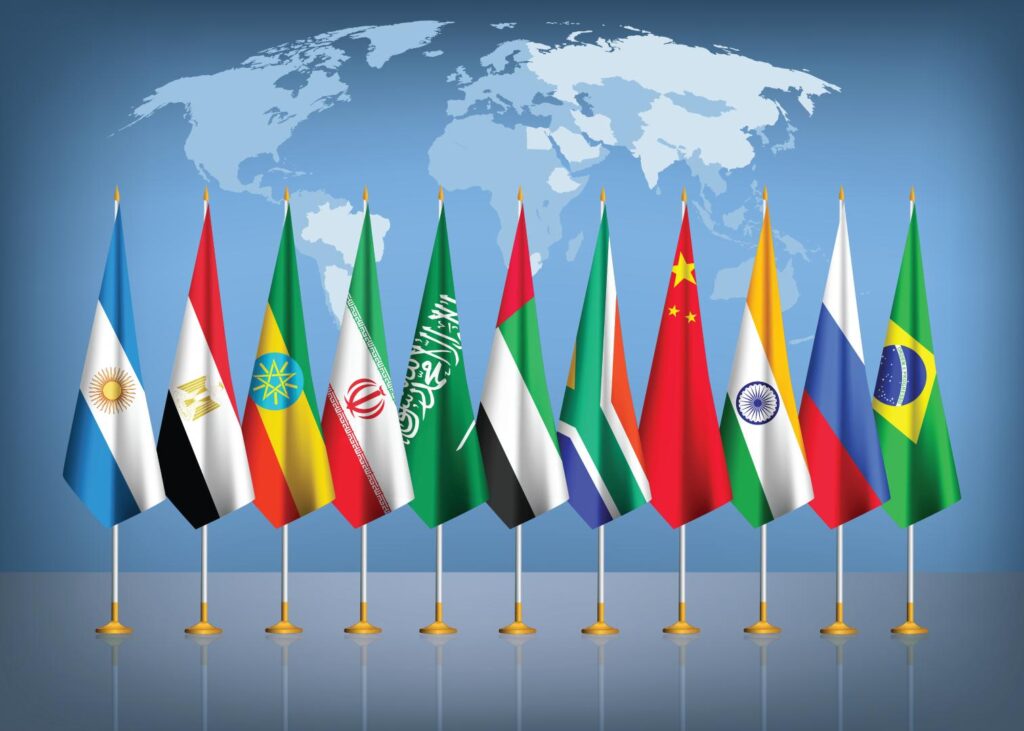
Meanwhile, major transitions were happening on the world stage. Thursday’s announcement from BRICS, a five-country economic grouping of Brazil, Russia, India, China, and South Africa, could have a significant impact on power brokerage ahead. BRICS currently represents over 40% of the world’s population. The inclusion of Argentina, Egypt, Ethiopia, Iran, Saudi Arabia, and the United Arab Emirates spans a wide range of economies, some struggling and some thriving, and paves the way for future expansions, especially to include countries that have historically hesitated to “take sides” between existing economic power blocs.
With many pursuing extraordinary political goals as of late, it’s often less a matter of who sticks the landing, and more of how well braced the rest of us are for its impact.
BRICS presents an alternative to G7 decision-making about international investments and developmental policies: a would-be champion of developing and historically underserved nations. Many of those, however, have been hesitant to lean into a power bloc that might undermine existing relationships with G7 countries, so they’ve been waiting to see how BRICS pursues its ambitious goals. Russia’s war in Ukraine, for instance, has caused problems for the New Development Bank, an alternative investment source to the IMF and World Bank that was co-founded by the now deeply embargoed global power.
BRICS members are also divided on the right path forward. Brazil holds strong ties with the US even as it supports the inclusion of Iran, with which the US has an antagonistic relationship, and which alluded to such during summit proceedings. India also maintains strong ties with the US, while weaning itself off the dollar. China, champion of Ethiopia’s inclusion, is keen to see more of Africa (in which it has invested heavily in infrastructure) given a seat at the table, and retains a strong desire to counter US dominance on the world stage.
Xi Jinping’s absence from a key BRICS address raised eyebrows, though. Commerce Minister Wang Wentao read a prepared speech in his stead, with sharp allusions to the US in its appeal to more global collaboration for national development:
Everything we do is to deliver better lives to our people. But some country, obsessed with maintaining its hegemony, has gone out of its way to cripple the EMDCs [Economically More Developed Countries]. Whoever is developing fast becomes its target of containment; whoever is catching up becomes its target of obstruction. But this is futile, as I have said more than once that blowing out others’ lamp will not bring light to oneself. … Deliberately creating division with the assertion of “democracy versus authoritarianism” and “liberalism versus autocracy” can only split the world and lead to clash of civilizations. Xi Jinping’s speech at BRICS, as read by Wang Wentao, CGTN, August 23
As with Putin, who attended virtually because of an active arrest warrant from the International Criminal Court for crimes against humanity, the CCP government is no stranger to absences: the foreign minister, Qin Gang, hasn’t been seen in public since he was replaced, and before then was strikingly absent at another international meeting. Xi’s absence wasn’t for long (he showed up for dinner), but what strikes international observers is the lack of transparency among Chinese media around the event, along with Xi’s relatively low profile in the past month.
That lack of transparency also emerged in the fallout of Prigozhin’s presumed death, which along with the death of second-in-command Dmitry Utkin leaves a power void in a military outfit with significant influence in conflict zones in Ukraine and across Africa. US intelligence joins the view of international experts that the plane was targeted for assassination, not shot down in the course of war. Although Russian government historically denied a relationship with Wagner Group, that story changed more recently to acknowledge a relationship with the so-called private army, and then to assert that it “fully financed” the organization.
READ: Wagner Group in Sudan: The paramilitarization of war continues
Wagner Group’s command structure is kept tightly under wraps, leaving many to speculate about the direction it will take going forward. If it is indeed orchestrated centrally by the Kremlin, there is a strong likelihood of new leadership emerging discreetly, to maintain the facade of distance between Russian government and Wagner’s intrusive actions in other countries’ political affairs.
One of those intrusive actions relates to pro-Russia campaigning in Niger, which this week was also officially suspended by the African Union as a consequence of its late-July coup, which installed a military leadership over a country with a high rate of civilian poverty and a significant amount of prospective mining industry. The latter has historically been a site of interest for Wagner (and Russia), which uses its forces to shore up authoritarians in exchange for mining profits and exports.
We certainly don’t lack for “interesting times”, on Earth or any other celestial bodies we’ve made a recent habit of junking up. But with many pursuing extraordinary political goals as of late, it’s often less a matter of who sticks the landing, and more of how well braced the rest of us are for impact.