
Source: The Globe and Mail | Original Published At: 2025-04-28 20:22:02 UTC
Key Points
- Russia announces 72-hour ceasefire during Victory Day (May 8-10) coinciding with WWII anniversary
- Ukraine rejects ceasefire as insincere, demanding immediate cessation of hostilities
- Kremlin links ceasefire to Western cessation of military aid to Ukraine
- Zelensky renames Victory Day to Europe Day to distance Ukraine from Russian influence
- Lavrov reiterates Russia's maximalist demands including recognition of annexed territories
- Trump's proposed peace deal rejected by Russia despite perceived pro-Moscow bias
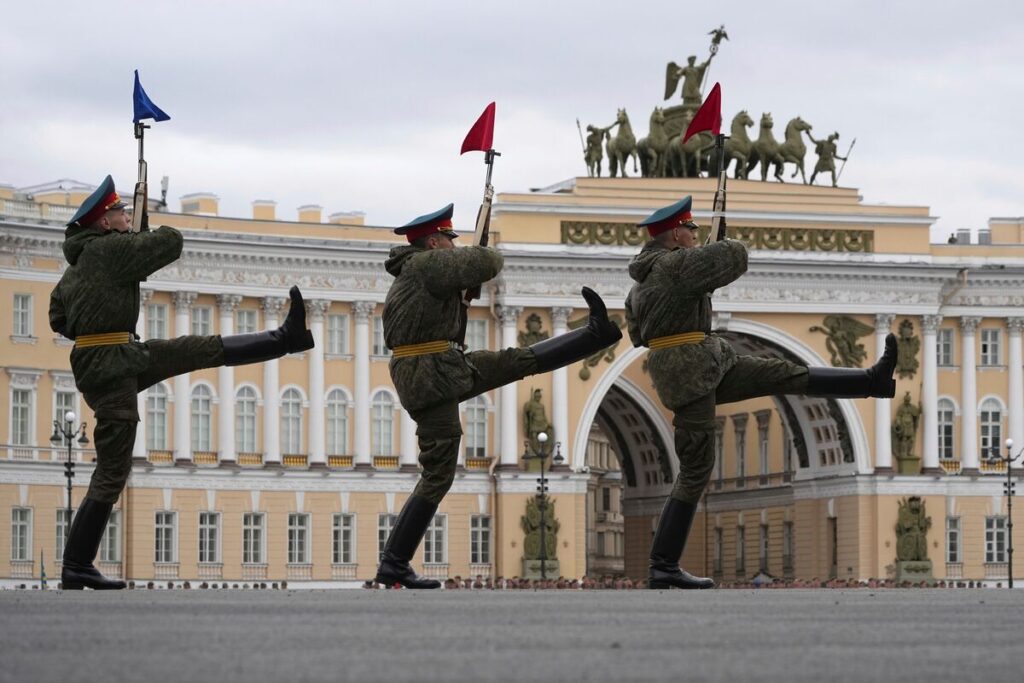
Open this photo in gallery: Honour guard soldiers march during a rehearsal for the Victory Day military parade, which will take place at Dvortsovaya Square on May 9 to celebrate 80 years after the victory in World War II, in St. Petersburg, on April 22.Dmitri Lovetsky/The Associated Press
Russian President Vladimir Putin declared Monday that his forces in Ukraine will observe a three-day ceasefire early next month, even as the Kremlin repeated maximalist demands that make a longer-term peace deal unlikely.
The May 8 to 10 ceasefire, if it happens, will coincide with the 80th anniversary of the Allied victory in the Second World War. In most years, the event is marked with a massive military parade, heavy on the symbology of the Soviet Union, in Moscow’s Red Square. Mr. Putin’s ally Chinese President Xi Jinping is expected to stand alongside him at this year’s celebration, and some reports suggest North Korean dictator Kim Jong Un – who has sent his country’s troops to fight alongside the Russian army – may attend as well.
Opinion: Federal leaders should commit to designating Russia a terrorist state
Russia made the unilateral ceasefire offer after it effectively rejected a 30-day ceasefire proposed by the United States and accepted by Ukraine. Ukrainian Foreign Minister Andrii Sybiha challenged Moscow to agree to a ceasefire that “is real, not just for a parade.”
“If Russia truly wants peace, it must cease fire immediately. Why wait until May 8th?” he wrote on social media.
The Kremlin has indicated it would only commit to the 30-day ceasefire if the West agreed to stop supplying Ukraine with weapons.
Mr. Putin’s offer of a Victory Day truce is not an easy one for Ukrainian President Volodymyr Zelensky to embrace. For decades, Victory Day was a major holiday in Ukraine as well as Russia, serving as a reminder of both the millions of Ukrainians who lost their lives in the war against Nazi Germany, and of a time when Ukraine was ruled by Moscow as part of the Soviet Union.
After Mr. Putin ordered the full-scale invasion of Ukraine in 2022, Mr. Zelensky signed a decree changing the name of the holiday to Europe Day, reflecting Ukraine’s desire to escape Russian domination and to join the European Union and the North Atlantic Treaty Organization.
Mr. Putin previously declared a 30-hour ceasefire over Easter weekend; it resulted in a drop-off in fighting, but not a complete cessation.
Tens of thousands of people have been killed, and millions more have been driven from their homes, in more than 38 months of warfare that has left Russia in control of about 20 per cent of Ukrainian territory. Russian troops continue to advance along much of the 1,000-kilometre-long battlefront, though progress has been incremental and costly.
U.S. President Donald Trump has been trying to push the two sides toward a peace deal that would freeze the conflict along its current lines, with the U.S. controversially extending recognition to Russia’s 2014 seizure and annexation of Crimea from Ukraine, among other concessions. In return, Ukraine would receive only vague security assurances, while also being prohibited from joining the NATO military alliance.
Even as Mr. Trump’s proposed deal is seen as heavily tilted in Moscow’s favour, Russian Foreign Minister Sergey Lavrov made it clear that it still falls well short.
In an interview with Brazil’s O Globo newspaper, Mr. Lavrov said it was “imperative” that Russia’s hold on not just Crimea, but four other Ukrainian regions that it claims to have annexed, receive international – not just American – recognition. Russian troops currently control only parts of the Donetsk, Luhansk, Zaporizhzhia and Kherson regions.
According to a transcript of the interview posted Monday to the official Kremlin website, Mr. Lavrov said Russia would insist on “the abolition of sanctions, lawsuits and arrest warrants” – an apparent reference to the Western sanctions imposed on Russian individuals and entities since 2014, as well as the International Criminal Court warrants seeking the arrest of Mr. Putin and other senior Russian officials in connection with alleged war crimes.
Open this photo in gallery: Russia’s Foreign Minister Sergey Lavrov arrives for the BRICS foreign ministers’ meeting at Itamaraty Palace in Rio de Janeiro, April 28.Bruna Prado/The Associated Press
Mr. Lavrov said Russia would also demand the “demilitarization and denazification” of Ukraine – based on the fictitious claim that Mr. Zelensky’s government is fascist – as well as changes to Ukrainian law to protect the country’s Russian speakers and the Russian Orthodox Church from what the Kremlin says is official persecution.
Many of Russia’s key demands have remained unchanged since the start of the invasion, and Mr. Lavrov gave no perceptible ground in the direction of Mr. Trump’s proposal. The White House has repeatedly signalled that the President may soon give up on his efforts to forge a peace deal if the two sides don’t come to an agreement.
On Saturday, Mr. Trump and Mr. Zelensky held a one-on-one meeting in Rome before the funeral for Pope Francis. Afterward, Mr. Trump – who has repeatedly attacked Mr. Zelensky in the past and portrayed him as the main obstacle to peace – made a rare criticism of Mr. Putin and Russia’s nightly missile and drone attacks on Ukrainian cities.
Mr. Putin’s apparent response was the three-day ceasefire idea. In a statement carried Monday by the official TASS newswire, the Kremlin said “Russia believes that the Ukrainian side should follow suit” but that its troops would “give an adequate and effective response” should Kyiv not adhere to the Victory Day truce.