
Six countries to join BRICS group; China labels expansion ‘historic’
Source: The Washington Post | Original Published At: 2023-08-24 12:20:05 UTC
Key Points
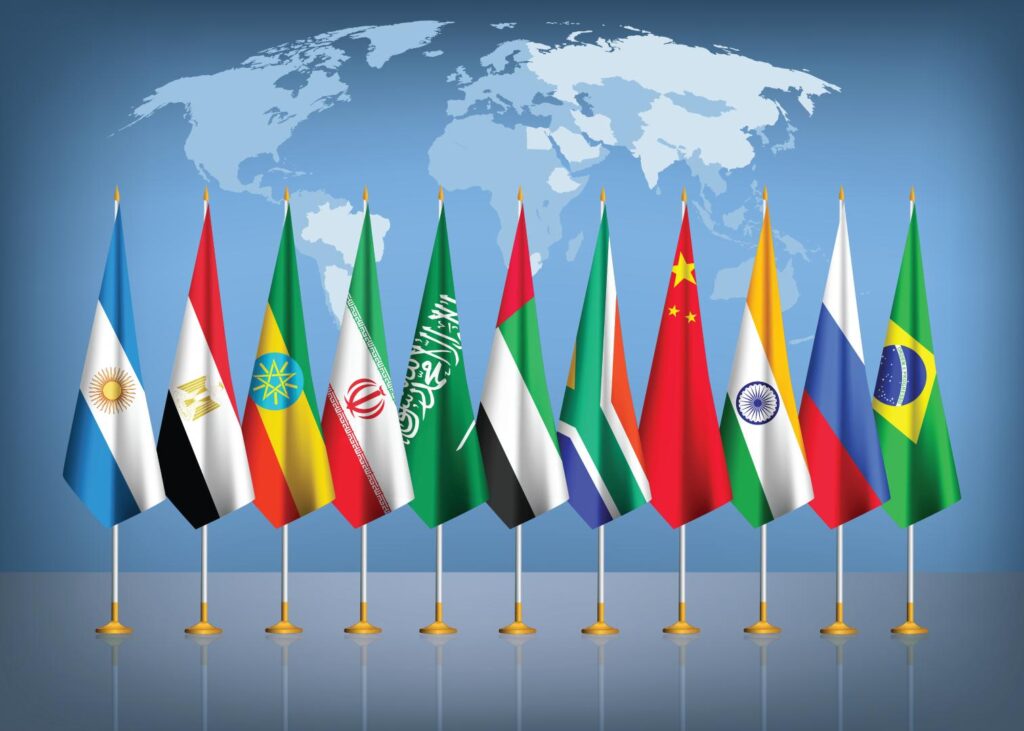
- BRICS expands from 5 to 11 members with Argentina, Egypt, Ethiopia, Iran, Saudi Arabia, and UAE joining in January 2024
- China and Russia aim to create a counterweight to Western-dominated financial and trade systems
- Expansion described as 'historic' by Xi Jinping, emphasizing alternative non-Western frameworks
- Sanctions on Russia over Ukraine war accelerate efforts to build resilient supply chains
- India and Brazil express reservations about anti-U.S. agenda despite alignment with BRICS goals
The BRICS grouping of Brazil, Russia, India, China and South Africa will add six nations to its ranks next year, as Beijing and Moscow push for the loose collection of emerging economies to evolve into a robust counterweight to Western global dominance. Argentina, Egypt, Ethiopia, Iran, Saudi Arabia and the United Arab Emirates will join as members in January, the summit host, South African President Cyril Ramaphosa, said Thursday, the last day of the three-day meeting in Johannesburg. The announcement marked the first expansion since South Africa joined in 2010 at the invitation of China.
For Beijing and Moscow, adding members is part of a long-running — and often frustrated — effort to turn a largely symbolic grouping into a vehicle for remolding international trade and finance structures to protect their interests against future sanctions from the United States and its allies.
Xi Jinping, China’s powerful leader, on Thursday hailed the “historic” expansion, which he said would be a “new starting point for BRICS cooperation.” This year has seen “the most open and explicit push from Xi Jinping to turn the BRICS into a kind of ‘anti-hegemonic’ vehicle,” said Andrew Small, a senior fellow at the German Marshall Fund.
Xi’s speeches have been “a blow-by-blow case against the U.S. alliance system and U.S.-dominated financial systems,” as well as a pitch for building “alternative, non-Western frameworks” for developing countries to trade, Small said. Sanctions targeting Russia over the war in Ukraine have added urgency to China’s effort to create alternative global financial structures and supply chains resilient to Western disruption.
Not all members are fully aligned with China and Russia’s geopolitical stance, and some potential parts of the long-term strategy — such as reducing reliance on the dollar in trading — remain experimental.
But, Small said, the intent is clear. “It’s part of the long-term bet China has made. They think relations with the West are going to deteriorate and the future of relations with the world will be rooted in the developing world, so they want to find ways to institutionalize and entrench resilient systems,” he said.
After an unexplained absence Tuesday, Xi reappeared Wednesday with calls for BRICS to fight decoupling, supply chain disruption and “economic coercion.” Echoing Russian President Vladimir Putin, the Chinese leader took thinly veiled swipes at the United States for “hegemonic” behavior. “It can’t be that whoever has the thicker arm or the loudest voice has the final say,” he said.
In a sign of his international isolation, Putin appeared over video link. If he had attended in person, South Africa would have been legally obliged to arrest him because he faces war crimes charges in the International Criminal Court.
Although India and Brazil have reservations about the growing anti-U.S. agenda, China and Russia have found some developing nations more receptive to their concerns about American dominance, which is part of the motivation for more members, analysts said.
While the developing world has always been central to Beijing’s efforts to remake multilateral organizations to protect its interests, souring relations with the United States and Europe have prompted Xi to double down on a strategy of currying favor in emerging markets.
On top of a decade of the Belt and Road investment initiative, Xi has announced three globe-spanning projects since 2021 to promote Chinese views on development, security and “civilization.” Even as Chinese loans and investment in the Belt and Road initiative have fallen dramatically since a peak in 2016, China’s overall trade with members has continued to grow and recently surpassed total trade with the United States, European Union and Japan. (Some E.U. members are part of the initiative.)
Some Chinese scholars believe that Beijing has greater space to maneuver in part because Russia’s invasion of Ukraine has distracted the United States from engagement with developing nations.
The war and China-U.S. trade tensions mean that Washington has shifted its focus to the Group of Seven and is less interested in the Group of 20, creating an opportunity for BRICS to become a better platform for large developing countries to speak up, said Wu Xinbo, a scholar at Fudan University in China.
The summit sent a clear message to the United States and its allies that “you cannot contain or suppress China because it has friends all over the world,” said Ming Jinwei, an independent political commentator.
Ming, who previously worked as an editor at the state-run Xinhua News Agency, likened Beijing’s approach to the guerrilla warfare tactics of Mao Zedong during the Chinese civil war. Then, the Communists won against the Nationalists in part by taking over villages surrounding cities to isolate and encircle the enemy. The same tactic will eventually work against the United States, he wrote.
The “China-U.S. contest may still be locked in a stalemate, but the end result is inevitable,” he wrote on WeChat, the social media app.