
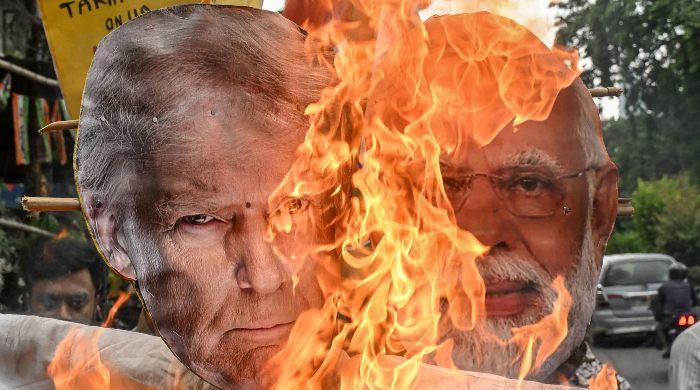
India readies for punishing US tariffs
Source: Geo.tv | Original Published At: 2025-08-26 04:38:00 UTC
Key Points
- US threatens 50% tariffs on Indian exports over Russian oil purchases
- Potential GDP growth reduction to below 6% (weakest since pandemic)
- Textiles, seafood, and jewellery sectors face immediate job loss risks
- India prepares $2.8 billion exporter relief package and tax cuts
- Diplomatic tensions risk pushing India closer to China and Russia
- Pharmaceuticals and electronics (e.g., iPhones) temporarily exempt
MUMBAI: Indian exports to the United States will face some of the highest tariffs in the world this week, barring a last-minute reversal from President Donald Trump.
Trump has tied issues of war and peace to trade, threatening to slap 50% duties on New Delhi in retaliation for its continued purchases of Russian oil — which Washington argues help finance Moscow’s war in Ukraine.
The tariff offensive has rattled US-India ties, given New Delhi a new incentive to repair relations with Beijing, and carries major consequences for the world’s fifth-largest economy.
Trump issued a three-week deadline on August 6, which is expected to take effect on Wednesday morning in India.
Analysts at Nomura warn that 50% duties would be “akin to a trade embargo”, devastating smaller firms with “lower value add and thinner margins”.
Elara Securities’s Garima Kapoor said no Indian product can “stand any competitive edge” under such heavy import taxes.
Economists estimate tariffs could shave 70 to 100 basis points off India’s GDP growth this fiscal year, dragging growth below 6%, the weakest pace since the pandemic.
Exporters in textiles, seafood and jewellery are already reporting cancelled US orders and losses to rivals such as Bangladesh and Vietnam, raising fears of heavy job cuts.
A small reprieve: pharmaceuticals and electronics, including iPhones assembled in India, are exempt for now.
S&P estimates exports equivalent to 1.2% of India’s GDP will be hit, but says it will be a “one-off” shock that “will not derail” the country’s long-term growth prospects.
Indian Foreign Minister Subrahmanyam Jaishankar fired back, arguing India’s purchases helped stabilise global oil markets — and were done with Washington’s tacit approval in 2022.
He argued that both the United States and Europe buy refined oil and associated products from India.
“If you have a problem buying oil from India, oil or refined products, don’t buy it”, he said, speaking in New Delhi. “Nobody forced you to buy it — but Europe buys, America buys.”
Jaishankar said that, until Trump’s ultimatum, there had been “no conversations” asking them to stop buying Moscow’s oil.
Trade trackers at Kpler say India’s stance will become clearer only in September, as most August shipments were contracted before Trump’s threats.
Experts say India is in a tricky situation.
India needs “considerable ingenuity and flexibility” to escape “what appears to be a no-win situation”, said Nandan Unnikrishnan of New Delhi-based Observer Research Foundation.
Washington, Unnikrishnan argued, is telling India: “We think that you are the weakest link in the Russia-Ukraine geopolitics chain”.
New Delhi has sought to bolster its economy while deepening ties with both BRICS partners and regional rivals.
Jaishankar flew to ally Moscow, producing pledges to ease barriers to bilateral trade, while Prime Minister Narendra Modi is preparing his first visit to China in seven years to repair long-frosty relations.
Domestically, Indian media reports that the government is working on a $2.8 billion package for exporters, a six-year programme aimed at easing liquidity concerns.
Modi has also proposed tax cuts on everyday goods to spur spending and cushion the economy.
Talks have stumbled over agriculture and dairy.
Trump wants greater US access, while Modi is determined to shield India’s farmers, a huge voter bloc.
Indian media reports suggested that US negotiators cancelled a planned late-August trip to India. That sparked speculation that discussions had broken down.
Jaishankar, however, says talks are continuing, adding drily: “Negotiations are still going on in the sense that nobody said the negotiations are off,” he said. “And people, people do talk to each other.”