
Indonesia’s Prabowo adopts softer tone on Israel, but can he balance domestic sentiments with geopolitical gains?
Source: CNA | Original Published At: 2025-11-03 22:00:00 UTC
Key Points
- Indonesia's President Prabowo Subianto has made unprecedented statements suggesting conditional recognition of Israel if Palestinian statehood is recognized.
- Domestic opposition to Israel remains strong, with 74.9% of Indonesians opposing recognition of Israel according to a 2025 survey.
- Potential benefits for Indonesia include access to Israeli military technology, improved US relations, and support for OECD membership.
- Indonesia maintains its stance that any engagement with Israel must prioritize Palestinian statehood recognition first.
- Prabowo's administration faces challenges balancing geopolitical gains with domestic political and religious sensitivities.
JAKARTA: A pledge to recognise Israel if the Jewish state does the same for Palestinian statehood, an offer to send peacekeeping troops to Gaza, and a high-profile attendance at a Trump-led peace summit.
These recent moves involving Indonesia have cast a spotlight on its stance towards Israel and the Palestinian issue, with observers noting a subtle shift under President Prabowo Subianto’s charge.
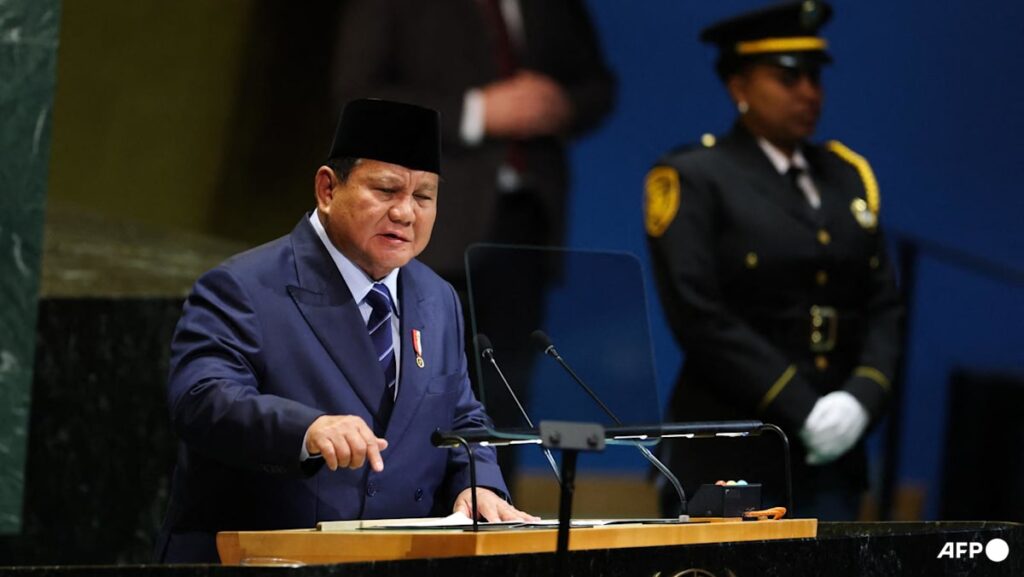
In particular, they point to his pledge at the United Nations General Assembly (UNGA) on Sep 23 to recognise Israel, if the latter recognised Palestinian statehood, as an unprecedented move.
He also said the world must “recognise and guarantee the safety and security of Israel”, striking a tone markedly different from his predecessors, who have long prioritised Palestinians’ right to self-determination over Israel’s security concerns.
Observers note that these remarks reflect a pragmatic tone of late to the decades-long conflict between Israel and the Palestinian territories.
“No Indonesian leader has promised to recognise Israel if Israel recognises a Palestinian state,” said Made Supriatma, a visiting fellow at Singapore-based think tank ISEAS-Yusof Ishak Institute.
Indonesia does not have formal diplomatic relations with Israel, and efforts to change this are often met with harsh public backlash across the political spectrum. Indonesia recognised the state of Palestine in 1988.
The seemingly softer approach, coupled with Prabowo’s offer made in the same UNGA speech to send 20,000 peacekeeping troops to Gaza, is a way to show leaders of the world that Indonesia is a force to be reckoned with, some experts said.
“(Prabowo) wants to show (the world) that Indonesia matters, that we are a big nation and we can offer workable solutions and results,” said Yohanes Sulaiman, an associate professor in international relations at Universitas Jenderal Achmad Yani.
These and other moves by Prabowo have been noticed.
On Oct 13, Prabowo became the only Southeast Asian leader invited to Sharm el-Sheikh in Egypt, where leaders of the United States, Turkiye, Qatar and Egypt signed a declaration aimed at cementing a ceasefire in Gaza. At the peace summit, US President Donald Trump praised Prabowo as “a very incredible man from Indonesia”.
Some former leaders learnt it the hard way, like Indonesia’s fourth president Abdurrahman Wahid, who ruled between 1999 and 2001.
The late president was widely criticised after suggesting shortly after he came into power that Indonesia should open diplomatic channels with Israel to boost economic cooperation and push for peace.
Subsequent presidents have shied away from openly engaging in talks with Israel, let alone be seen as supporting it.
Anti-Israel sentiment remains deeply entrenched in the Muslim-majority country. A June 2025 survey by Indonesian research firm Median found that 74.9 per cent of Indonesians believe Indonesia should never recognise Israel.
Backlash against those seen as sympathetic to Israel has also been swift and severe. In July last year, Indonesia’s largest Islamic organisation, Nahdlatul Ulama, dismissed several members for accepting an invitation to meet Israel’s President Isaac Herzog in Israel.
More recently, University of Indonesia, one of the country’s top universities, was forced to apologise after inviting a pro-Israel academic, Peter Berkowitz, to speak at a campus event in August.
Indonesians also reacted harshly when several Israeli media outlets reported that Prabowo was scheduled to visit Israel after attending the Gaza peace summit in Egypt. Foreign Minister Sugiono promptly issued denials of any such trip and affirmed longstanding support for the Palestinians in Gaza.
POTENTIAL BENEFITS
Notwithstanding public sentiment, experts said there are potential benefits for Indonesia, Palestinians and Israel – should Indonesia and Israel forge ties.
“Prabowo stands to gain access to Israeli military technology, strengthen security cooperation and potentially improve alignment with Western partners like the US,” said Dedi Dinarto, lead Indonesia analyst at public policy advisory firm Global Counsel.
Israel could also be key to Indonesia’s bid to become a member of the Organisation for Economic Cooperation and Development (OECD), an intergovernmental organisation comprising mostly developed countries.
Accepting new countries to the organisation requires unanimous approval from members, which include Israel.
Indonesia aims to become an advanced economy by 2045 and began the OECD accession process in February 2024.
In April last year, however, after media reports suggesting Indonesia would normalise diplomatic ties with Israel in exchange for OECD membership, the foreign ministry came out to reject the notion.
“I affirm that, as of now, there are no plans to establish diplomatic relations with Israel, particularly given Israel’s actions in Gaza,” then-ministry spokesperson Lalu Muhamad Iqbal said.
Forging ties with Israel could benefit the Palestinian cause by creating new diplomatic channels for dialogue, some analysts argued.
“It could open back-channel diplomacy, giving Indonesia a more credible role in advocating for Palestinian interests,” Dedi said.
As for Israel, formal ties with Indonesia would provide not only a vast and untapped market of 280 million people but also a powerful ally in the Muslim world.
“That’s why the Israelis have high regard for Prabowo Subianto. They hope Indonesia will switch from non-recognition to recognition,” said Teuku Rezasyah, an international relations expert from Padjadjaran University.
Indonesia’s foreign ministry has maintained that any diplomatic gestures or engagements involving Israel are grounded in Indonesia’s long-standing commitment to securing recognition for an independent and sovereign Palestinian state.
“There will be no recognition or normalisation with Israel, whether through the Abraham Accords or any other platform, unless Israel first recognises an independent and sovereign Palestinian state,” said foreign ministry spokesperson Yvonne Mewengkang.
The Abraham Accords are a set of agreements that established diplomatic normalisation between Israel and several Arab states.
A Nov 1 report by news agency AP on the possibility of Indonesia-Israel normalisation suggested that the White House might hold some cards it could play in this regard.
It cited greater US investment in Indonesia’s rare earths industry as an example and quoted former top State Department official Daniel Shapiro as saying that “Trump’s transactional dealmaking opens up possibilities that otherwise might not exist”.
BALANCING DOMESTIC SENTIMENTS AND GEOPOLITICAL GAINS
Experts noted the backlash against Prabowo’s recent moves and statements has so far been minimal.
One reason, they say, is that Prabowo faces virtually no opposition in parliament. Even the Indonesian Democratic Party of Struggle (PDI-P), Indonesia’s biggest political party, has refused to call itself an opposition party despite not being in Prabowo’s coalition.
Meanwhile figures from major Islamic organisations have been co-opted into his administration. Nahdlatul Ulama has nine members serving in Prabowo’s Cabinet, while members of Muhammadiyah, the country’s second-largest Islamic organisation, hold six positions.
“The Islamic political forces that have been the driving force behind pro-Palestine demonstrations have been co-opted by the Prabowo regime,” said Made.
Still, this stability could prove fragile — particularly if the delicate truce between Israel and Hamas collapses and violence flares up again in Gaza, analysts said.
“The impression that Indonesia is giving in too much to Israel and the US could spark anger on the streets,” said Teuku of Padjadjaran University.
“Furthermore, Prabowo’s stance could alienate countries that have long stood alongside Indonesia in defending Palestinian rights, leading them to feel they no longer share an ideological ally in Jakarta.”
Prabowo will likely calculate his next move carefully, experts said.
“While opening up to Israel could bring tangible strategic benefits, including access to cutting-edge Israeli technology and improved ties with Washington, Indonesia still has alternative pathways without inflaming domestic opposition,” Yohanes of Universitas Jenderal Achmad Yani said.
Experts say recognising Israel could also convince Washington that Indonesia is an ally committed to advancing its interests. “America could even trust us to buy an F-35, something which Indonesia is very keen to get its hands on,” Yohanes said of the US’s most advanced fighter planes which Washington restricts to close allies.
But Jakarta is not without options.
Indonesia is already a member of the economic bloc BRICS and can explore alternative defence cooperation, such as purchasing China’s fifth-generation J-20 fighter jets, he said.
“It is great if Israel can help with these things but for Prabowo, it does not mean Indonesia can be pushed around,” Yohanes continued.
For now, Prabowo seems willing to tolerate some domestic pushback for strategic geopolitical gains, said Dedi of Global Counsel.
But if domestic criticism of his approach intensifies, Prabowo could revert to the harsher tone adopted by his predecessors.
“Prabowo risks angering religious and conservative groups who see engagement with Israel as a betrayal of Palestine … but the risk is manageable if engagement stays discreet,” Dedi said.
“What is possible is selective, low-profile cooperation – defence, intelligence, or economic channels – without sparking a political crisis.”
There are also lines Indonesia is presently not willing to cross. “Allowing Israeli athletes and officials to come to Indonesia and possibly waving the Israeli flag is one of those lines,” said international relations expert Teuku.
“Is normalisation of diplomatic ties one of those lines? With the current anti-Israel sentiment, I believe we are still years away from that ever happening.”