
The View From India
Source: The Hindu | Original Published At: 2025-07-14 11:11:00 UTC
Key Points
- Trump labeled BRICS 'anti-American' and threatened tariffs on members aligning with the group
- BRICS members united in opposing U.S. tariffs and condemning Israel's attack on Iran
- India seeks to resolve tariff disputes with the U.S. while maintaining BRICS commitments
- BRICS Cross-Border Payments Initiative challenges dollar dominance through local currency trade
The 17th BRICS summit, held in Rio de Janeiro, Brazil, triggered an angry response from U.S. President Donald Trump, after the grouping criticised his tariffs and condemned U.S.-Israel’s attack on Iran. BRICS, which began as an economic acronym referring to Brazil, Russia, India and China (South Africa joined later), has evolved as the main institutional voice of the Global South. Last year, BRICS added five new members — Egypt, Ethiopia, the UAE, Iran and Indonesia. This year’s summit had assumed greater significance because of the global faultlines. It took place just weeks after Iran, a member country, was attacked. In the summit, the member countries, often pulled into different foreign policy directions, showed unity on two issues — on Mr. Trump’s tariff threats and the attack on Iran. The group’s July 6 declaration raised “serious concerns” about the tariffs, which it said were “inconsistent with WTO rules”. The 10-member grouping also termed the strikes on Iran, which started on June 13 triggering the 12-day Israel-Iran war, “a violation of international law and the Charter of the United Nations”. Member countries also “expressed serious concern over any attacks against peaceful nuclear installations that are carried out in violation of international law and relevant resolutions of the International Atomic Energy Agency” and pledged to “remain seized of the matter”.
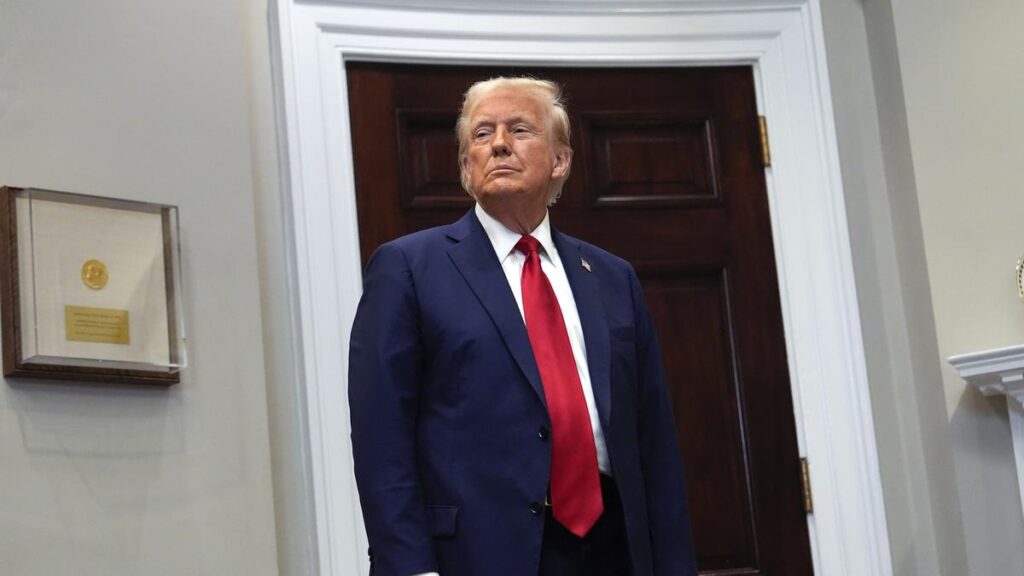
Mr. Trump lashed out at BRICS as “anti-American” and threatened to impose an additional 10% tariffs on countries aligning with the policies of the grouping. “BRICS is not, in my opinion, a serious threat. But what they’re trying to do is destroy the dollar so that another country can take over and be the standard, and we’re not going to lose the standard at any time,” he said. In addition to the threatened 10%, the Trump administration has slapped 50% tariffs on Brazil for the “witch-hunt” against former Brazilian President Jair Bolsonaro, who faces charges of attempted coup. The U.S. has also imposed 30% tariffs on South Africa after accusing it of unequal trade. Besides, Republican Senators plan to bring a Bill called the Sanctioning Russia Act of 2025 that seeks to place 500% tariffs on imports of oil and sanctioned Russian products, which would hurt Russia, as well as India and China, its two biggest importers.
This was not the first time Mr. Trump targeted BRICS. In January, immediately after he was sworn in for his second term, Mr. Trump called BRICS members “seemingly hostile countries.” “We are going to require a commitment from these seemingly hostile Countries that they will neither create a new BRICS Currency, nor back any other Currency to replace the mighty U.S. Dollar or, they will face 100% Tariffs,” he wrote in a social media post. He had made a similar comment in November 2024 as well.
Why is Trump attacking BRICS? Mr. Trump’s irritation, writes Suhasini Haidar in this explainer, appears to stem from BRICS declarations in South Africa in 2023 and Russia in 2024, where members discussed a BRICS Cross-Border Payments Initiative that aims to facilitate trade and investment within BRICS countries using local currencies and other mechanisms. The initiative built momentum due to the problems Western sanctions on Russia have meant for trading partners in the Global South.
India has dismissed Mr. Trump’s criticism that BRICS is anti-American. In March 2025, External Affairs Minister S. Jaishankar had said that India had no plans to replace the U.S. dollar. The government’s focus is now on clinching a trade agreement with the Trump administration seeking to resolve the tariff disputes. But at the same time, India remains committed to BRICS, which now represents about half the global population, around 40% of the global GDP and a quarter of global trade. “Despite all the challenges, the Rio declaration underlined the basic cohesion and consensus within BRICS members on a range of issues,” The Hindu wrote in this editorial. “As India prepares for its leadership of the BRICS grouping next year, it can move forward with this consensus, fulfilling the vision for the grouping’s acronym that Mr. Modi recast as “Building Resilience and Innovation for Cooperation and Sustainability”.