
Trump’s tariff rebuke, Xi’s handshake and Putin’s oil are India’s latest foreign policy test
Source: BBC | Original Published At: 2025-08-29 23:38:20 UTC
Key Points
- India faces diplomatic tensions with the US over Russian oil purchases and tariffs
- Strategic balancing act between Quad (US-led) and SCO (China/Russia-led) alliances
- Military-economic asymmetry with China highlighted by $99bn trade deficit
- Russia remains key energy partner despite Western sanctions
- Modi's China visit signals cautious rapprochement post-Galwan clashes
Trump’s rebuke, Xi’s handshake, Putin’s oil: India’s foreign policy test
1 day ago Share Save Soutik Biswas India correspondent Share Save
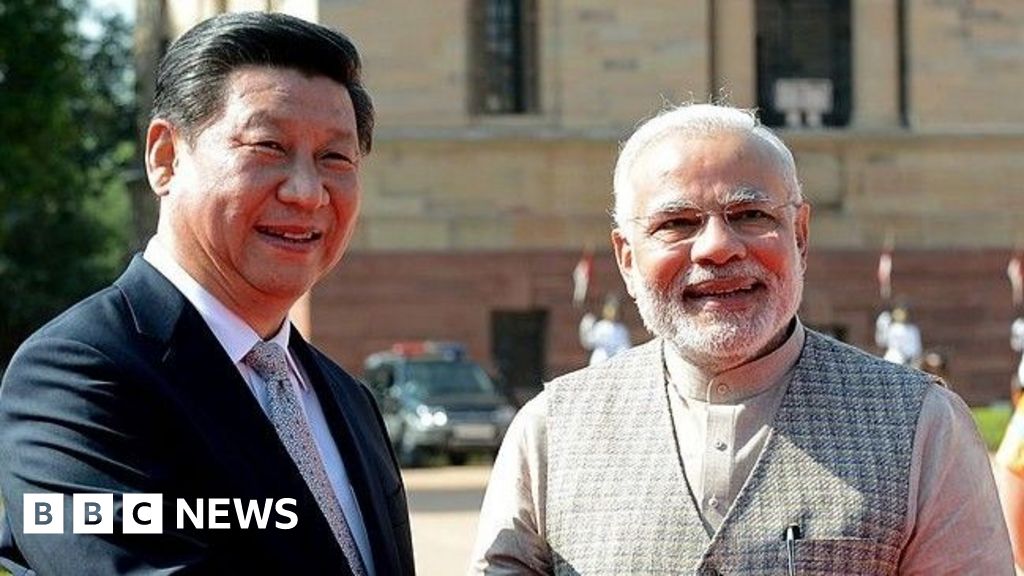
Getty Images Modi and President Xi have met more than a dozen times since 2014
“This is a time for us to engage America, manage China, cultivate Europe, reassure Russia, bring Japan into play, draw neighbours in, extend the neighbourhood and expand traditional constituencies of support,” Indian Foreign Minister S Jaishankar wrote in his 2020 book The India Way: Strategies for an Uncertain World. For over a decade, India has styled itself as a key node in a new multipolar order: one foot in Washington, another in Moscow, and a wary eye on Beijing. But the scaffolding is buckling. Donald Trump’s America has turned from cheerleader to critic, accusing India of bankrolling Moscow’s war chest with discounted oil purchases. Delhi now faces the sting of Trump’s public rebuke and higher tariffs. With multipolarity fraying, many say Prime Minister Narendra Modi’s planned meeting with Xi Jinping in Beijing on Sunday looks less like triumphal diplomacy and more like pragmatic rapprochement. Yet, Delhi’s foreign policy is at an uneasy crossroads. India sits in two camps at once: a pillar of Washington’s Indo-Pacific Quad with Japan, the US and Australia, and a member of the Shanghai Cooperation Organisation (SCO), the China and Russia-led bloc that often runs counter to US interests. Delhi buys discounted Russian oil even as it courts American investment and technology and prepares to sit at the SCO table in Tianjin next week. There’s also the I2U2 – a grouping of India, Israel, the UAE and the US that focuses on technology, food security and infrastructure – and a trilateral initiative with France and the UAE. Analysts say this balancing act is no accident. India prizes strategic autonomy and argues that engaging with competing camps gives it leverage rather than exposure. “Hedging is a bad choice. But the alternative of aligning with anyone is worse. India’s best choice is the bad choice, which is hedging,” Jitendra Nath Misra, a former Indian ambassador and currently a professor at OP Jindal Global University, told the BBC. “India may not be fully confident of holding its own by aligning with a great power. As a civilisational state, India seeks to follow the course of other great powers in history who achieved that status on their own.”
AFP via Getty Images Relations between India and US have soured since Modi met Trump at the White House in February
To be sure, India’s global ambitions still outpace its capacities. Its $4tn economy makes it the fifth largest, but that is a fraction of China’s $18tn or America’s $30tn. The military-industrial base is even thinner: India is the world’s second largest importer of arms and not among the top five arms exporters. Despite self-reliance campaigns, indigenous platforms remain limited and most high-value military technology is imported. Analysts say this mismatch shapes India’s diplomacy. It’s a reality which, many believe, underpins Modi’s visit to China amid what appears to be a cautious thaw in ties, frozen after the deadly Galwan clashes of 2020. (Nothing captures this imbalance between the two countries more starkly than India’s $99bn trade deficit with China, which exceeds its defence budget for 2025–26.) Underscoring the shift in relations, China’s envoy in Delhi Xu Feihong recently denounced Washington’s steep tariffs on Indian goods, calling the US a “bully” . Last week, Chinese Foreign Minister Wang Yi echoed the conciliatory tone during a Delhi visit, urging the neighbours to see each other as “partners” rather than “adversaries or threats”. Still, critics ask: Why is India choosing to open a strategic dialogue with Beijing now? Happymon Jacob, a strategic affairs scholar, poses the blunt question in a post on X: “What is the alternative?” For decades to come, he argues, managing China will be India’s “core strategic preoccupation”. In a separate article in The Hindustan Times newspaper, Mr Jacob also situates the recent talks between Delhi and Beijing in a broader frame: the trilateral interplay of India, China and Russia. These three-way conversations, he notes, reflect wider realignments in response to US policy and allow Delhi and Beijing to signal to Washington that alternative blocs are possible. But Mr Jacob also cautions that without normalcy with India, China can’t leverage “Indian unhappiness” with Trump for its “own larger geopolitical purposes”. The larger picture is about how far big powers can really reconcile. As Sumit Ganguly of Stanford University’s Hoover Institution points out, US-China rivalry remains “structurally irreconcilable”, while Russia has been reduced to Beijing’s “junior partner”. Against this backdrop, India’s room for manoeuvre becomes clearer. “India’s current strategy, as far as I can discern, is to try and maintain a semblance of a working relationship with China to buy time,” he told the BBC.
AFP via Getty Images Modi, Putin and Xi at the Brics summit in Russia in 2024
When it comes to Russia, India has shown little inclination to bend to US pressure. Discounted crude from Moscow remains central to its energy security. Jaishankar’s recent visit to Moscow signalled that despite Western sanctions and Russia’s deepening dependence on China, Delhi still sees value in keeping the relationship warm – both as an energy lifeline and as a reminder of its foreign policy autonomy. Mr Ganguly says India is also deepening its relationship with Russia largely because of two reasons: it fears a further closing of ranks between Moscow and Beijing, and due to the souring of ties between Delhi and Washington under Trump. Trump’s repeated claims of brokering an end to the recent war with Pakistan have irked Delhi, while a much-hyped trade deal appears to have stalled, reportedly over US demands for greater access to India’s farm markets. Trump’s public rebukes over cheap Russian oil have added to the chill – a stance India finds inexplicable since China is a far bigger buyer. Yet, history suggests that even serious rifts have not derailed relations when larger interests were at stake. “We have faced the toughest challenge until the next toughest challenge,” says Mr Misra. He points to Washington’s tough sanctions after India’s nuclear tests in 1974 and again in 1998, moves that isolated Delhi and strained ties for years. Yet less than a decade later, the two managed to stitch together a landmark civilian nuclear deal, signalling a willingness on both sides to overcome mistrust when strategic logic demanded it. The deeper question, as analysts now argue, is not whether ties will recover but what shape they should take.
LightRocket via Getty Images Indian students carry a poster of Trump and Modi outside their school in Mumbai