
No substitute for Asean even as South-east Asian countries express interest in joining Brics: Vivian
Source: The Straits Times | Original Published At: 2024-06-26 13:26:00 UTC
Key Points
- ASEAN remains central to regional economic architecture despite interest in Brics expansion
- Thailand, Malaysia, Myanmar, and Laos have expressed interest in joining Brics
- ASEAN's economic potential highlighted: 680M population, $3.5T GDP projected to grow
- ASEAN has trade agreements with China, South Korea, Japan, and digital economy partnerships
- Call for deeper ASEAN integration, infrastructure investment, and openness to investments
SINGAPORE – Even though several South-east Asian countries have expressed interest in joining the Brics economic bloc, there is no substitute for Asean, said Foreign Minister Vivian Balakrishnan.
“I think there is no question the key game in town in our part of the world is Asean,” he said in a media interview on June 26 as he wrapped up a two-day visit to Thailand.
There is no substitute for Asean as an organising unit, a production, investment or competitive zone, he said, noting the region has 680 million people, with a combined gross domestic product of around US$3.5 trillion (S$4.75 trillion) that can potentially double and quadruple in the next two to three decades.
Earlier in June, Thailand and Malaysia revealed that they plan to join Brics, a group of emerging economies led by Brazil, Russia, India, China and South Africa that is seen to be challenging the Western-led global order. Myanmar and Laos had previously declared interest in joining the bloc.
Dr Balakrishnan highlighted that Asean has signed trade pacts with countries such as China, South Korea and Japan.
Asean countries, too, have tie-ups such as the Digital Economy Partnership Agreement founded by Singapore, Chile and New Zealand, which South Korea has joined and Thailand has expressed interest in joining.
The attempts of Asean countries to broaden markets and reach a wider audience do not hinder the overall growth of the bloc and bilateral economic relations, he said.
“As long as these measures lead to greater openness, inclusiveness, a level playing field and make member states more attractive for investments and promote trade, we’re in support of all these exploratory moves,” he added.
Within Asean, countries need to double down on integration and connectivity and boost investments in infrastructure to enhance competitiveness, he said.
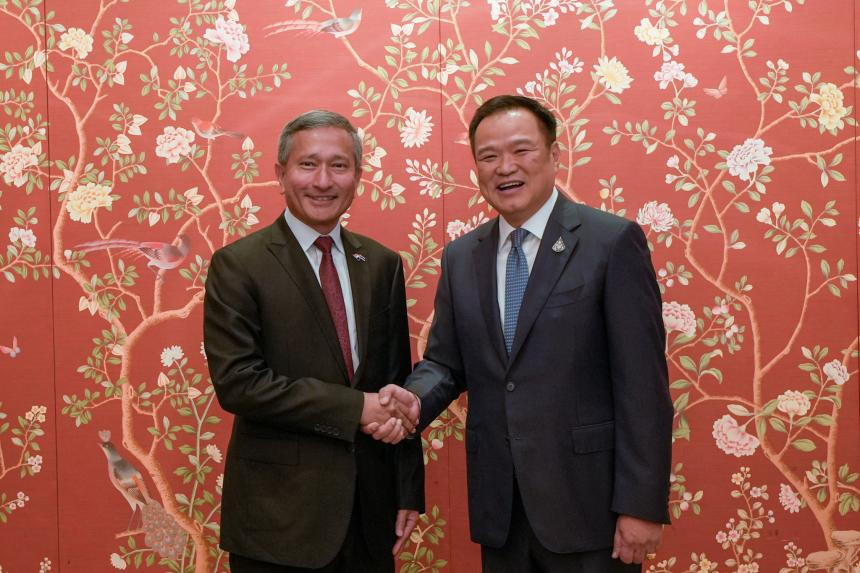
Dr Balakrishnan was in Thailand on an official visit from June 25 to 26 at the invitation of his Thai counterpart Maris Sangiampongsa.
On June 26, he delivered the opening remarks at the coordinating meeting of the Thailand-Singapore Civil Service Exchange Programme.
The programme, established in 1997 and now in its 14th edition, gathers civil servants from both countries to share ideas and experiences in areas such as health, leadership development and education.
In his speech, Dr Balakrishnan said the global economic paradigm is under pressure in a fractured world with wars in Ukraine and Gaza, and maritime tensions in the Pacific and South China Sea.